

Stop Leaving Money on the Table: How to Choose Your Pricing Model
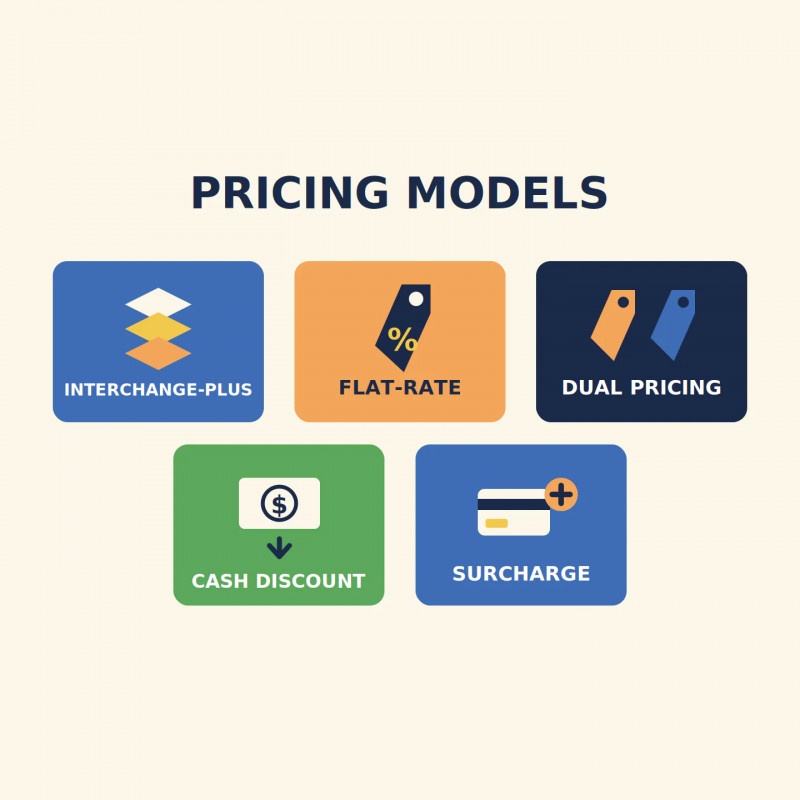
Table of Contents
- What is a Pricing Model
- Interchange+
- Flat Rate Pricing
- Tiered Pricing
- Dual Pricing
- Surcharging
- What works for your business
- Final Thoughts
What is a Pricing Model?
In the payment processing industry, pricing models are what dictates how much a merchant pays in fees for accepting credit and debit card transactions. They all have different use cases that make them unique and effective. Some models include your entire cost through a single flat percentage rate, and others help to drop your overall processing cost as low as possible.
In this article, we will focus on the five most popular pricing models that you will undoubtedly hear about while shopping for a payment processor.
Interchange+ (Recommended)
Businesses pay:
• Interchange fees, dues and assessments
• Plus a small processor markup
Interchange+ is the most transparent pricing model and most common among businesses who accept card payments. All interchange rates and fees for every card type, along with the processor’s markup fees, are explicitly disclosed on monthly processing statements making this pricing model the easiest and simplest way to know exactly what your business is paying for.
This transparency is precisely why it has become the standard pricing model for card payments. The processor's markup remains fixed and your business pays lower interchange when a customer pays with a debit card rather than credit card. There are additional interchange programs as well like Visa’s CEDP to lower processing costs on business credit cards and purchasing cards.
This pricing model ultimately protects your bottom line by ensuring your processor can’t quietly hike up fees without your knowledge.
Flat Rate Pricing
Flat-rate pricing charges the same rate for every transaction, and is usually dependent on whether the transaction is card-present or card-not-present.
Example:
• 2.60% + $0.10 per card-present transaction, and
• 3.50% + $0.30 per card-not-present transaction
This model is simple and predictable, which makes it popular among small businesses with low average ticket amounts. It is rarely the most cost-effective pricing type for most businesses though, since the flat rate percentages can be far more expensive than what Interchange+ pricing would charge.
Large competitors in the payments industry like Square, Stripe, and Toast all utilize this flat rate pricing model. While the consistency of a flat percentage rate is simple, your business will ultimately pay well above the average for standard payment processing fees.
Tiered Pricing
Tiered pricing groups transactions into categories labeled:
• Qualified
• Mid-Qualified
• Non-Qualified
Qualified rates are the best possible rates your business can achieve, and non-qualified rates are the worst. On many occasions, payment processors will disclose the low, qualified rates up-front with the business to generate interest, but then fail to explain the non-qualified rates and how those impact their bottom line. This model generally offers less fee transparency and can lead to higher overall costs.
Additionally, selecting a tiered pricing model introduces the risk of transaction downgrades. Downgrading means the transaction fails to meet the risk criteria set by the card brands, and will switch to a more expensive mid-qualified or non-qualified category if any of the following situations occur:
• Settlements are delayed over 48 hours
• There is missing transaction data like AVS or ZIP codes
• The transaction amounts do not match between authorization and settlement
• There is missing commercial data for corporate or purchasing cards
Downgrades can cause transaction rates to reach the worst non-qualified tier and cost your business anywhere from 0.30% to 1.00% more than a qualified rate. That increase in cost could amount to thousands of dollars in unrealized revenue per year.
Dual Pricing
Dual pricing is a model where a business displays two distinct prices for every item or service - one price for cash transactions, and one price for card transactions.
This pricing model helps businesses achieve significantly lower processing fees because they can build in their known costs to the listed card price, meaning the customer will pay that cost. The cash price is discounted since there is no processing fee involved.
The benefits of this model is that the business can offset nearly 100% of their processing costs in a legal and transparent manner. Customers also are typically happier with this model since it is transparent and the fees for cards are not hidden.
Surcharging
Surcharging is the practice of adding a percentage fee to a transaction when a customer chooses to pay by credit card.
Surcharging, unlike dual pricing, keeps one standard price listed for each item or service. Then if a credit card is used for payment, a surcharge fee applies and must be disclosed on the receipt. Businesses are also required to make their customers aware of the surcharge through signage at (1) each business entrance, (2) each point-of-sale station, and (3) on all invoices.
While surcharging seems like a perfect fit for most businesses to greatly offset their processing costs, they must still consider the strict legal regulations per state and other regulations administered by card networks.
For example, the surcharge amount cannot exceed the merchant’s cost of accepting the card, capped at 3%, and it is illegal to surcharge a debit or prepaid card under any circumstance. Additionally, some states like Connecticut, Massachusetts and Maine have deemed surcharging to be fully illegal. Violating these rules and regulations can result in significant fines which is why it is important to choose a processing provider that will help to correctly set up the program for your business.
Surcharging is a great way for a business to save money on credit card interchange, and then only pay for debit card fees and monthly fees.
What works for your business
Choosing the right pricing model depends entirely on your business size, industry and processing volume.
Startups, Micro-merchants, and low-volume businesses processing under $10,000-15,000 per month
• Ideal fit is flat rate pricing because it is predictable fixed monthly expenses over small margins. This helps business owners who want to avoid monthly subscriptions and fluctuating fee amounts.
Established Businesses, High-volume merchants, and B2B companies
• Interchange+ pricing is the perfect fit and gold-standard in these business types. This pricing model helps achieve the lowest possible processing costs and complete transparency into exactly what is being charged.
Professional Services (Lawyers, Accountants, Contractors), low-margin industries, and businesses with high average ticket sizes
• PolyPay’s recommended pricing model for businesses that offer professional services is Surcharging. It works best in industries where invoices are common and clients expect to absorb the costs of processing when not using bank transfers or checks.
Retail shops, gas stations, convenience stores and quick service restaurants
• Dual pricing is a great option for these businesses since they are usually based in physical storefronts where foot traffic is high and cash is consistently flowing through the business. Visible cash discounting acts as an incentive for buyers to use cash and help avoid the costs of processing card payments.
Final Thoughts
There is no “perfect” pricing model - the best option is the one that compliments your business type perfectly. Choosing between these models requires a close look at your business’s transaction volume, average ticket size and how your customers prefer to pay. These factors can help guide you to make a decision that works best for your business.
Take the time to analyze your monthly statements, understand your customers, and don’t be afraid to ask questions to your processor. Picking the right model ensures you aren’t leaving money on the table later down the line. If this sounds like too much work or if you would like a professional to review this for you, contact us today and we will analyze your statement for you, find you the right solution, and a pricing model that works best with your business for FREE.